Image

Guitarist Hopes To Play Again With The Help of Bionic Hand Screenshot-sm 72

Dorian Cox, the 27-year-old guitarist of the indie band The Long Blondes, thought his guitar playing days were over after he suffered a stroke. He now has a glimmer of hope thanks to some neurological physiotherapy which includes a cutting-edge piece of medical technology. The SaeboFlex helps patients by supporting their wrists and helping them grasp and release objects. "It's a fantastic service, it's helping tremendously and I think it can work wonders for me and others — it's almost like a gym for my hand. I know things might never be the same again and nobody can give me a definite answer about whether I'll play guitar again but I'm getting back on track with their help," Mr. Cox said. This thing looks really cool, and I'm sure many people will benefit from it, though I can't help but wonder if they make a model that lets you shoot your fist at an enemy.

Microsoft

Look What's Cooking At Microsoft Labs 125

stinkymountain writes "Writer John Brandon spent two days at Microsoft Research Labs in Redmond and got an inside look at some pretty interesting projects under development, including a robotic receptionist, a new type of touch screen for people with fat fingers, and an electronic table that allows multiple people to collaborate in real time. Brandon also talks about some of these research projects on this NPR podcast."
AMD

45nm Opteron Performance, Power Efficiency Tested 129

An anonymous reader writes "Now that Intel has unleashed its next-generation Core i7 processors, all eyes are turned to AMD and its incoming wave of 45nm CPUs. To get a feel for AMD's future competitiveness, The Tech Report has taken a pair of 2.7GHz 45nm Opterons (with 75W power envelopes) and put them through the paces against Intel Xeons and older, 65nm Opterons in an extensive suite of performance and power efficiency tests — from Cinema 4D and SPECjbb to computational fluid dynamics and a custom XML handling benchmark. The verdict: AMD's new 45nm quad-core design is a notable improvement over the 65nm iteration, and it proves to be a remarkably power-efficient competitor to Intel's Xeons. However, 45nm AMD chips likely don't have what it takes to best Intel's Core i7 and future Nehalem-based Xeons."
Technology

Accident Could Lead To Better Digital Cameras 120

Dave Bullock (eecue) writes "Scientists at UCLA have accidentally created a material that will some day give us better, faster, cheaper, more flexible digital cameras. I toured their lab and shot a photo essay for Wired. Personally I'm looking forward to a quantum-dot embedded camera sensor someday soon. 'Graduate student Hsiang-Yu Chen was working on a new formula for solar cells when something went wrong. Instead of creating electricity when hit with light, the conductivity of the material she was working with changed. "The original purpose [was] to make a solar cell more efficient," says Chen. "However, during the research we found the solar cell phenomenon [had] disappeared." Instead, the test material showed high gain photoconductivity, indicating potential use as a photo sensor.'"
Wireless Networking

Atheros Hardware Abstraction Layer Source Is Released 117

chrb writes "With the recent discussion here on proprietary blobs in the Linux kernel, it's nice to see that today Sam Leffler has released the source for the Atheros Hardware Abstraction Layer under the ISC license, which is both GPL and BSD compatible. The Atheros chipset is used in many laptops, so this is another important step towards running a completely free distribution."
Data Storage

On the State of Linux File Systems 319

kev009 writes to recommend his editorial overview of the past, present and future of Linux file systems: ext2, ext3, ReiserFS, XFS, JFS, Reiser4, ext4, Btrfs, and Tux3. "In hindsight it seems somewhat tragic that JFS or even XFS didn't gain the traction that ext3 did to pull us through the 'classic' era, but ext3 has proven very reliable and has received consistent care and feeding to keep it performing decently. ... With ext4 coming out in kernel 2.6.28, we should have a nice holdover until Btrfs or Tux3 begin to stabilize. The Btrfs developers have been working on a development sprint and it is likely that the code will be merged into Linus's kernel within the next cycle or two."
Hardware Hacking

The State of Open Source Hardware In 2008 88

ptorrone writes "MAKE Magazine has put together their 3rd annual 'State of Open Source Hardware 2008' — in just a few years, the number of projects has grown from a small handful to an amazing 60+ offerings. Similar to open source software, open source hardware is available with source code, schematics, firmware and bills of materials, and allows commercial use. The most popular project, Arduino, the open source prototyping platform for artists and engineers, has shipped over 60,000 units." The article is formatted such that the first link for a particular device will usually take you to the project home page. Some will bring you instead to where you can purchase the items, but most still have a "How To" tab which will direct you to guides and instructions on how to build your own gadgets. There are a bunch of interesting devices, from the Game of Life on the outside of a cube to a home-made MP3 player to OpenMoko.
Cellphones

Linux Kernel Booting On the iPhone 115

mhm was one of many readers to note that the Linux 2.6 kernel has been ported to the iPhone. "Planetbeing, one of the iPhone devteam members, has been working on porting Linux to the iPhone (along with a custom bootloader called OpeniBoot). Today they managed to boot the kernel! Video showing the boot process has been posted. Instructions and binaries are available on the project blog."
Power

Ubiquitous Hydrogen Power Not Getting Any Closer 267

NewScientist has a story about the "hydrogen economy" that has been resting on the horizon for a decade or more. Despite a great deal of enthusiasm for and research into hydrogen-based power systems, the technology seems just as far away from everyday use as it's always been. A British startup, ITM Power, has recently claimed a breakthrough in lowering production costs by using a nickel catalyst (rather than platinum) with a membrane small enough for home use. But, even if their method is proven and adopted, it still wouldn't address huge energy efficiency problems in the process. "The point was made forcefully by Gary Kendall of the conservation group WWF in a recent report called Plugged In (PDF, pgs. 135-149). Kendall, a chemist who previously spent almost a decade working for ExxonMobil, highlights how the energy losses in the fuel chain - from electrolysis to compression of the hydrogen for use to inefficiencies in the fuel cell itself — mean that only 24 per cent of the energy used to make the fuel does any useful work on the road."
Government

IT Cutbacks For 2012 London Olympics 190

Slatterz writes "The IT backbone for the London 2012 Olympic and Paralympic Games is to be cut. According to the Games' chief integrator, Michele Hyron of Atos Origin, each section of the computing infrastructure will be made more efficient in order to minimise redundant equipment and hopefully reduce energy consumption. Unlike the Beijing Games, the results will be relayed via the public wireless network which will be available in the Olympic Park — this means cutting out the 2,500 results terminals. The team of workers will deliver more than 1,000 servers, 10,000 PCs and 4,000 printers."
Data Storage

Micron Demos SSD With 1GB/sec Throughput 120

Lucas123 writes "Micron demonstrated the culmination of numerous technology announcements this year with a solid state disk drive that is capable of 1GB/sec throughput with a PCIe slot. The SSD is based on Micron's 34nm technology and interleaving 64 NAND flash chips in parallel. While the techology, which is expected to ship over the next year, is currently aimed at high-end applications, a Micron executive said it's entirely possible that Micron's laptop and desktop SSDs could have similar performance in the near future by bypassing SATA interfaces."
Education

Computer For a Child? 556

jameswing writes "I am thinking of buying a UMPC, such as an Eee PC or a Wind for my son, and wanted to get input from Slashdot. He is almost 2 and really curious about our computers, and anything electronic. I want to foster this in him, without having him on my desktop or laptop. I also don't really like the idea of getting one of those cheap 'Learning Laptops' that have a tiny screen and are really limited. Does anybody have one that they use with their children? How sturdy is it? Will it stand up to a 2-year-old? If not, what are good alternatives? What are your thoughts? Suggestions?"
Portables

Fujitsu Offers Free Laptop Upgrades For Life 166

Barence writes "Fujitsu Siemens is offering its customers free laptop upgrades for life with its Lifebook4Life scheme. Customers buying a Fujitsu Siemens Lifebook will be offered a free upgrade three years after their original purchase, and every subsequent three years for the rest of their life — as long as they purchase an extended three-year warranty. Customers will have to hope inflation stays low, though: the value of each new notebook cannot exceed the value of the previous one, adjusted 10% for inflation. Fujitsu says the scheme is profitable, and a raft of small print ensures plenty of people will find they've excluded themselves from the scheme for all sorts of reasons."
Image

Farmer Builds Robot Army Screenshot-sm 106

46-year-old Wu Yulu has only a basic school education but has managed to build himself 26 robots from scrap materials over the past 30 years. At first his creations were simple and could barely shuffle along by themselves. The robots got more complex as time passed, and eventually he built ones capable of climbing walls, serving water, lighting cigarettes, playing musical instruments and writing calligraphy. "When I was 11, one day I was sitting on the doorstep, and while watching villagers passing by I suddenly came up with the idea of building a machine that walks like a man," he told the Beijing Times.
Robotics

Robots Debut In Japanese Theater Production 75

An anonymous reader writes "BBC News and CNET Cutting Edge are reporting on a new play starring at Osaka University, in which two Mitsubishi Wakamaru robots interact with human actors and move around the stage. Named 'Hataraku Watashi' ('I, Worker'), the play is authored by Oriza Hirata, a renowned playwright. It focuses on a robot who complains about his boring and demeaning jobs."
Transportation

Bay Area To Install Electric Vehicle Grid 388

Mike writes "Recently San Francisco, San Jose, and Oakland unveiled a massive concerted effort to become the electric vehicle capitol of the United States. The Bay Area will be partnering with Better Place to create an essential electric vehicle infrastructure, marking a huge step towards the acceptance of electric vehicles as a viable alternative to those that run on fossil fuels." Inhabitat.com has some conceptual illustrations and a map showing EV infrastructure, such as battery exchange stations, stretching from Sacramento to San Diego — though this is far more extensive than the Bay Area program actually announced, which alone is estimated to cost $1 billion.
Robotics

Ethical Killing Machines 785

ubermiester writes "The New York Times reports on research to develop autonomous battlefield robots that would 'behave more ethically in the battlefield than humans.' The researchers claim that these real-life terminators 'can be designed without an instinct for self-preservation and, as a result, no tendency to lash out in fear. They can be built without anger or recklessness ... and they can be made invulnerable to ... "scenario fulfillment," which causes people to absorb new information more easily if it agrees with their pre-existing ideas.' Based on a recent report stating that 'fewer than half of soldiers and marines serving in Iraq said that noncombatants should be treated with dignity and respect, and 17 percent said all civilians should be treated as insurgents,' this might not be all that dumb an idea."
HP

HP Creates First Hybrid Memristor Chip 155

An anonymous reader writes "HP researchers have built the first functioning hybrid memristor-transistor chip. Lead researcher Stanley Williams and his team built the very first memristor — the '4th fundamental element' of integrated circuits after resistors, capacitors and inductors — back in April. Memristors can remember their resistance, leading to novel electronic capabilities. The new FPGA circuit uses memristors to perform tasks normally carried out by (many more) transistors and is therefore smaller, more power efficient and cheaper to make, HP says. Memristors could also turn out to be a more compact, faster alternative to flash memory."
Hardware Hacking

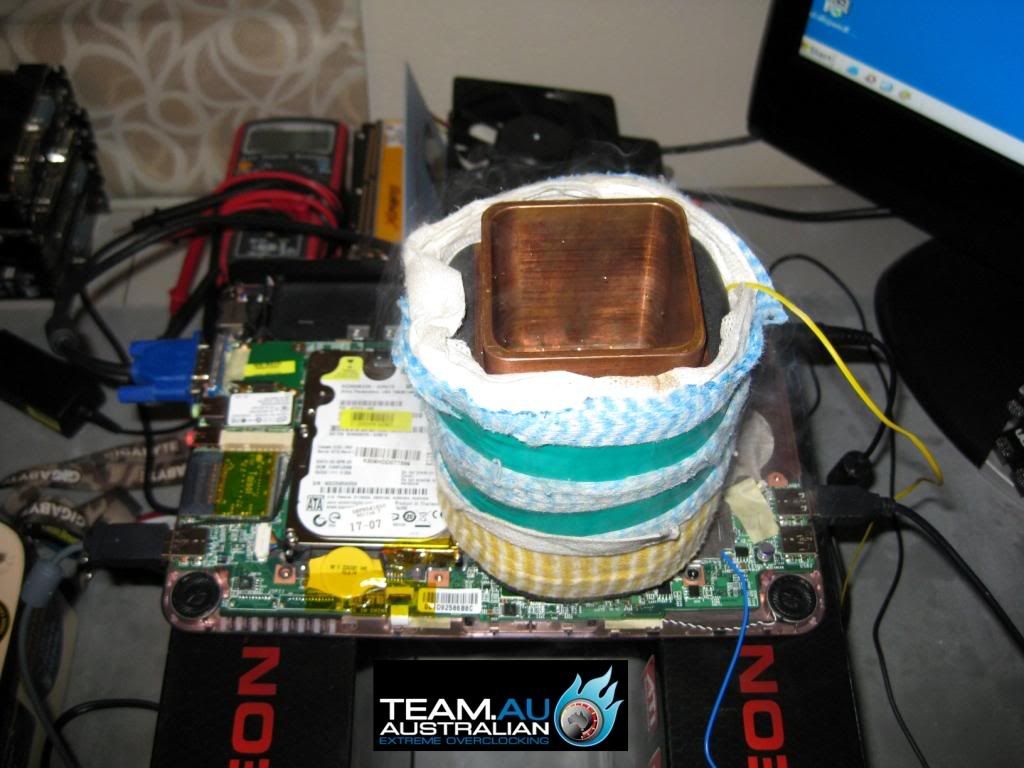
MSI Wind U100, Overclocked With Liquid Nitrogen 95

james writes "What do you get when you combine a MSI Wind U100 notebook with liquid nitrogen? The new Intel Atom frequency World Record ... and some damn cool pictures! A large copper pot is used, sitting on top of the GPU and chipset, and cold transfer through the original heatsink plate to the CPU. This was cooled down to about -20 C to achieve the new world mark. (Intel Atom N270 @ 2315mhz) For more information you can check out the original forum thread.

Slashdot Top Deals