Transportation

MIT Team Creates Shock That Recharges Your Car 281

An anonymous reader writes "If you had a GenShock, you may not mind those potholes in the road any longer because this new prototype shock actually harvests energy from bumps in the road to save on fuel. A team of students at MIT have invented a shock absorber that harnesses energy from small bumps in the road, generating electricity while it smooths the ride more effectively than conventional shocks. Senior Shakeel Avadhany and his teammates say they can produce up to a 10 percent improvement in overall vehicle fuel efficiency by using the regenerative shock absorbers. They also already have a lot of interest in their design, specifically the company that builds Humvees for the army are already planning to install them in its next version of the Humvee."
Data Storage

The Hairy State of Linux Filesystems 187

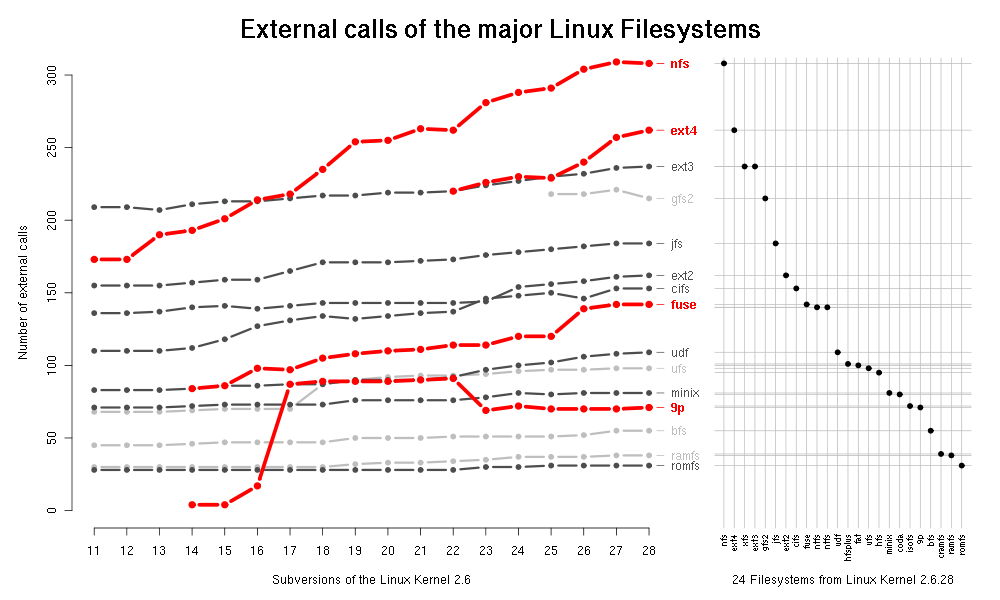
RazvanM writes "Do the OSes really shrink? Perhaps the user space (MySQL, CUPS) is getting slimmer, but how about the internals? Using as a metric the number of external calls between the filesystem modules and the rest of the Linux kernel I argue that this is not the case. The evidence is a graph that shows the evolution of 15 filesystems from 2.6.11 to 2.6.28 along with the current state (2.6.28) for 24 filesystems. Some filesystems that stand out are: nfs for leading in both number of calls and speed of growth; ext4 and fuse for their above-average speed of growth and 9p for its roller coaster path."
Power

Scientists Harvest Nano-Power From Hamsters 90

Al writes "Researchers at Georgia Tech have come up with the ideal way to test a new peizo-electric device that efficiently harvests power from bio-movement — attaching it to a hamster. The device contains a series of zinc-oxide nanowires mounted on top of a flexible plastic surface. As the plastic bends, the wires generate around a nanowatt of power. The Georgia Tech team, led by Zhong Lin Wang, wanted to show that their device could produce power from irregular movements so they attached it to a tiny hamster jacket. They also tried attaching it to a volunteer's finger. Here's a video of the hamster wearing his piezo-power outfit."
The Internet

UPS, Generators Join Servers For Boxed Data Centers 63

miller60 writes "As more companies look into using a 'data center in a box,' you can now get your UPS and generator in a box as well. HP and Sun have begun offering containerized power and cooling infrastructure along with their data center containers, offering an expansion path for facility owners that have run out of power and cooling capacity. Microsoft also plans to use containerized power and cooling in its next-generation facilities, allowing it to build them with no roofs (remember its tent data centers?)."
Hardware Hacking

Build a BoxeeBox and Wean Yourself From Cable 335

Since I've been having serious problems with satellite all week, DeviceGuru's submission was really interesting to me. He says "Inspired by Roku's awesome Netflix video download box and impressed with Boxee's free A/V media center platform, it was merely a matter of time before DeviceGuru blogger Rick Lehrbaum would create the BoxeeBox, an Ubuntu-powered HTPC with Boxee serving as its primary media center UI. Based on a 2.5GHz Core 2 Duo CPU, the BoxeeBox has the look and feel of consumer A/V equipment and packs 2GB RAM, 1TB HDD, CD/DVD drive, USB, Firewire, HDMI, DVI-D, RGB, and 8-channel surround sound audio."
Intel

Intel Moves Up 32nm Production, Cuts 45nm 193

Vigile writes "Intel recently announced that it was moving up the production of 32nm processors in place of many 45nm CPUs that have been on the company's roadmap for some time. Though spun as good news (and sure to be tough on AMD), the fact is that the current economy is forcing Intel's hand as they are unwilling to invest much more in 45nm technologies that will surely be outdated by the time the market cycles back up and consumers and businesses start buying PCs again. By focusing on 32nm products, like Westmere, the first CPU with integrated graphics, Intel is basically putting a $7 billion bet on a turnaround in the economy for 2010."
Intel

VIA Nano Bests Intel Atom In Netbook Benchmarks 130

Glib Piglet writes "ZDNet UK has a whole set of benchmarks comparing a 1.8 GHz Nano in VIA's Epia SN motherboard and a 1.6 GHz Atom in Intel's 'Little Falls' D945GCFL mobo. It's not good news for Chipzilla: 'As far as memory performance is concerned, the Nano is clearly superior in every test' and 'The VIA Nano emerges as the better processor for internet tasks. While the Atom needs 132.8 seconds to display simple HTML pages, the Nano does it in 70.1 seconds.' The Nano even outperforms Nehalem on one test. It's not all a win for VIA, though. The benchmark concludes that in some ways all netbooks, underpowered as they are, remain in the IT stone ages."
Transportation

Two Big Tests For Personal Rapid Transportation 299

Al writes "A novel kind of transit system, in which cars are replaced by a network of automated electric vehicles, is about to get its first large-scale testing and deployment. Two of these Personal Rapid Transit (PRT) systems are being installed this year, one at Heathrow International Airport, near London, and one in the United Arab Emirates, where it will be the primary source of transportation in Masdar City, a development that will eventually accommodate 50,000 people and 1,500 businesses and is designed to emit no carbon dioxide. The article examines these two systems and includes video that includes an animation of the PRT system in action."
Portables

Shifting Apps To ARM Chips Could Save Laptop Batteries 326

An anonymous reader writes "When is an Intel PC not an Intel PC? When it moves applications such as Internet browsing and email on to an ARM processor because it can get longer battery life. And according to a story at EE Times, this hybrid Intel-ARM processor approach is being taken by PC makers as prominent as Dell. The problem for Intel: Why would you switch out of 'all-day' mode and use the Intel processor? The problem for ARM: lacking support from Microsoft for Windows; the applications it runs for the PC have to do so under Linux."
Hardware Hacking

Stop-Motion Modbook Upgrade Video 14

Brian Northway writes "This funny, stop-motion, photo-animated video shows the process of converting an Apple MacBook to an Axiotron Modbook tablet, in one minute and fifty-nine seconds — viewable in standard quality or high-definition (720p), for exceptional detail. It's the latest installment a series of light-speed technical videos that I've created, wihich include the explorational disassembly of a PSP-3000, a unibody MacBook Pro, a MacBook Air, an iPhone, and many other Apple devices."
Hardware Hacking

Hackable Microcontroller-Powered Valentine's Card 133

compumike writes "If you have a significant other to impress this Valentine's Day, consider putting your programming skills to use. This video tutorial shows how to build an LED Heart Valentine's card, powered by a microcontroller running C code, with a neat randomized 'twinkling' effect in an interrupt handler. Think about it: how many ladies can say that their Valentine's card runs at 14 MHz?"
AMD

AMD Launches New Processor Socket Despite Poor Economy 215

arcticstoat writes to tell us that despite a poor economic climate, AMD is moving forward with a new processor socket launch, although they are trying to make it as upgrade-friendly as possible. "As you probably already know from the AM3 motherboards that have already been announced, AM3 is AMD's first foray into DDR3 memory support. As Phenom CPUs have integrated memory controllers, it's more accurate to say that it's the new range of Phenom II CPUs (see below) that are DDR3-compatible. However, the new DDR3-compatible Phenom II range is also compatible with DDR2 memory. As the new CPUs and the new AM3 socket are pin-compatible with the current AM2+ socket, you can put a new AM3-compatible CPU into an existing AM2+ motherboard. This means that you can upgrade your CPU now without needing to change your motherboard or buy pricey new DDR3 memory."
Hardware

Amazon Announces Kindle 2, With Slew of New Features 451

Engadget is reporting that Amazon has announced the new Kindle 2 for release on February 24th at a price point of $359. Thinner than an iPhone and coming standard with "Read-to-me" text-to-speech capability, the new device also has seven times more storage, faster page turning, a 16-level e-ink display, longer battery life, and a new five-way joystick. Looks like life just got a lot more interesting for fans of the original device. Engadget also has live coverage from the Kindle 2 press conference.
Power

DAM Pops Energy Star's Bubble 147

Martin Hellman writes "Last month we discussed a major problem with the EPA's Energy Star program. A Sony TV that was advertised to draw less than 0.1 watts in standby mode was actually drawing 15 watts — 150 times the stated value. A lack of information in the user manual and a poor response from Sony led me to suspect the problem was with the Electronic Program Guide feature, but a lack of information in the User Guide and a lack of response from Sony made it impossible to be sure — or to turn off the EPG. At current prices, that power consumption cost me about as much as a subscription to TV Guide magazine! The EPG was not as free as the on screen instructions would have you believe. Now, Device Guru reports on the resolution of that issue. As suspected, the problem was with the EPG, and there is a way to turn it off — now documented in that story. The problem is probably not unique to Sony or TVs that claim Energy Star compliance (devices are self-certified by the manufacturers!), so picking up a power meter is likely to have a good return on investment. As a result of this waste of power, the EPA is planning for future versions of the Energy Star requirements to limit the amount of time a TV can spend in Download Acquisition Mode (DAM) as the time for acquiring the EPG is known."
AMD

Nvidia Is Trying To Make an x86 Chip 420

Slatterz writes with a story from PC Authority which says that "Word has reached us that Nvidia is definitely working on an x86 chip and the firm is heavily recruiting x86 engineers all over Silicon Valley. The history behind this can be summarised by saying they bought an x86 team, and don't have a licence to make the parts. Given that the firm burned about every bridge imaginable with the two companies who can give them licences, Nvidia has about a zero chance of getting one."
Earth

Why Sustainable Power Is Unsustainable 1108

Urchin writes "Although scientists are agreed that we must cut carbon emissions from transport and electricity generation to prevent the globe's climate becoming hotter, the most advanced 'renewable' technologies are too often based upon non-renewable resources including indium and platinum — resources that could dry up in 10-15 years if they were widely used in the renewable energy market."
Patents

Is Apple's Multi-Touch Patent Valid? 112

An anonymous reader writes "There is evidence that Apple's multi-touch patent application may have failed to list some prior art that showed gestures in multi-touch interfaces as early as the mid 1980s. Some of these examples even appear in the bibliography of Wayne Westerman's doctoral dissertation, and he's one of the inventors on the application's list. If true, that could leave them wide open for legal attack, should they try suing someone like Palm for patent infringement. Also, Apple may be infringing some key multi-touch patents owned by the University of Delaware — and co-developed by Westerman while getting his doctorate."
Power

Universal Power Adapter Struggling For Support 277

Ian Lamont writes "Last year, there was a lot of hopeful discussion surrounding an initiative to have the consumer electronics industry standardize their products on a USB-based universal power adapter devised by Green Plug. Eight months later, the effort has stalled. The reason: manufacturers have balked from using Green Plug's technology. '... Gadget makers seem to have no compelling financial incentive to adopt Green Plug's technology. It would require them to add Green Plug's chip, or similar hardware and software, into every phone, camera, or music player they build, making them more expensive and more complicated to build. Another stumbling block for manufacturers: A universal power supply would kill the market for replacement power supplies. Manufacturers sell these at a steep markup price to customers who lose or break the original one that came with the device, and aren't tech-savvy enough to procure a low-cost generic replacement.' Green Plug is now trying to drum up public outcry through a (slow) website, but the number of supportive comments and votes remains relatively low."

Slashdot Top Deals