Security

IZON IP Cameras Riddled With Security Flaws 55

An anonymous reader writes "With recent action by the FTC against TRENDnet, the 'Internet of Things' has taken a sharp turn in the eyes of the public and government with regard to security. This week, Duo Security employee Mark Stanislav presented security research he did on the IZON IP camera from Stem Innovation. Through his testing, Mark found hardcoded credentials for Linux accounts (accessible by Telnet; Yes, — really), an undocumented web interface allowing for viewing a camera's stream (also with hardcoded credentials, user/user), and a variety of other failings including a lack of cryptography in most of the camera's functionality, including when uploading videos to Amazon Web Services's S3 storage." According to the above-linked article, "Contacted by The Security Ledger, Stem Innovation CTO Matt McBeth said that the IZON firmware, server system and iOS applications tested by Stanislav have since been updated, and that the research contains “inaccurate and misleading information.” Stem did not provide specific information about any inaccuracies."
Displays

4K Ultra HD Likely To Repeat the Failure of 3D Television 559

New submitter tvf_trp writes "Fox Sports VP Jerry Steinbers has just announced that the broadcaster is not looking to implement 4K broadcasting (which offers four times the resolution of today's HD), stating that 4K Ultra HD is a 'monumental task with not a lot of return.' Digital and broadcasting specialists have raised concerns about the future of 4K technology, drawing parallels with the 3D's trajectory, which despite its initial hype has failed to establish a significant market share due to high price and lack of 3D content. While offering some advantages over 3D (no need for specs, considerable improvement in video quality, etc), 4K's prospects will remain precarious until it can get broadcasters and movie makers on board."
Power

Researchers Tout Electricity Storage Tech That Could Recharge Devices In Minutes 31

coondoggie writes "Vanderbilt University researchers say they have come up with a way to store electricity on a silicon-based supercapacitor that would let mobile phones recharge in seconds and let them continue to operate for weeks without recharging. The Vanderbilt team said they used porous silicon -- a material with a controllable and well-defined nanostructure made by electrochemically etching the surface of a silicon wafer. This let them create surfaces with optimal nanostructures for supercapacitor electrodes, but it left them with a major problem: Silicon is generally considered unsuitable for use in supercapacitors because it reacts readily with some of chemicals in the electrolytes that provide the ions that store the electrical charge, the researchers said."
Graphics

Next-Gen GPU Progress Slowing As It Aims for 20 nm and Beyond 91

JoshMST writes "Why are we in the middle of GPU-renaming hell? AMD may be releasing a new 28-nm Hawaii chip in the next few days, but it is still based on the same 28-nm process that the original HD 7970 debuted on nearly two years ago. Quick and easy (relative terms) process node transitions are probably a thing of the past. 20-nm lines applicable to large ASICs are not being opened until mid-2014. 'AMD and NVIDIA will have to do a lot of work to implement next generation features without breaking transistor budgets. They will have to do more with less, essentially. Either that or we will just have to deal with a much slower introduction of next generation parts.' It's amazing how far the graphics industry has come in the past 18 years, but the challenges ahead are greater than ever."
Power

Silicon Supercapacitor Promises Built-in Energy Storage For Electronic Devices 95

Science_afficionado writes "A news release from Vanderbilt University begins, 'Solar cells that produce electricity 24/7, not just when the sun is shining. Mobile phones with built-in power cells that recharge in seconds and work for weeks between charges. These are just two of the possibilities raised by a novel supercapacitor design invented by material scientists ... that is described in a paper published in the Oct. 22 issue of the journal Scientific Reports. It is the first supercapacitor that is made out of silicon so it can be built into a silicon chip along with the microelectronic circuitry that it powers. In fact, it should be possible to construct these power cells out of the excess silicon that exists in the current generation of solar cells, sensors, mobile phones and a variety of other electromechanical devices, providing a considerable cost savings. ... Instead of storing energy in chemical reactions the way batteries do, “supercaps” store electricity by assembling ions on the surface of a porous material. As a result, they tend to charge and discharge in minutes, instead of hours, and operate for a few million cycles, instead of a few thousand cycles like batteries.' The full academic paper is available online."
Transportation

Tesla CEO Elon Musk: Fuel Cells Are 'So Bull@%!#' 479

Frosty P sends this quote from AutoblogGreen: "Elon Musk is unafraid to speak his mind. Whether he's talking about other players in the electric vehicle space or sub-par reporting from The New York Times, this is a man with few filters. Musk says that fuel cells are not part of the solution that electric vehicles offer for giving up the hydrocarbon addiction. After commenting that the only reason some automakers are pursuing hydrogen technology is for marketing purposes, that lithium batteries are superior mass- and volume-wise for a given range, and that fuel cells are too expensive, Musk capped it all off with the safety issue. 'Oh god, a fuel cell is so bull@%!#,' Musk said. 'Hydrogen is quite a dangerous gas. You know, it's suitable for the upper stage of rockets, but not for cars,' he said."
Cellphones

LG Launches Its Firefox OS Phone Fireweb for $200 91

SmartAboutThings writes "LG has launched the Fireweb Firefox OS smartphone in a joint event with the Telefonica Vivo carrier. The Fireweb Firefox OS smartphone will be available for around $200 and will join the Alcatel One Touch Fire which Telfonia is launching in Brazil, starting today. Mexico, Peru, and Uruguay are the next countries to get it. The Fireweb smartphone is LG's very first Firefox OS device and it increases the small number of OEMs that have released Firefox OS devices on the market. The smartphone has a 4-inch screen with a 480 x 320 display, a 1GHz Qualcomm processor and 4GB internal storage that can be expanded with the microSD card slot by up to 32GB. It has a 5-megapixel cameras that comes with both autofocusing and an LED flash, which is a first for Firefox OS phones." Hopefully an OEM releases a Firefox OS phone with beefier hardware, but you can't argue with the price.
Graphics

Improved Image Quality For HMDs Like Oculus Rift 55

An anonymous reader writes "The combination of smartphone panels with relatively cheap and light-weight lenses enabled affordable wide-angle Head Mounted Displays like the Oculus Rift. However, these optics introduce distortions when viewing the image through the HMD. So far these have been compensated for in software by using post-processing pixel shaders that warp the image. However, by doing so a loss in image quality (sharpness) can be perceived. Now researchers from Intel found a way around this error by using different sampling for rendering, therefore potentially increasing the image quality of all current and future HMDs with a wide field of view." Rather than applying barrel distortion to the final raster image, the researchers warp the scene geometry during rasterization. However, it currently requires ray tracing so it's a bit computationally expensive. Note that a vertex transformation can be used (with tessellation used to enhance the approximation), but the results are of variable quality.
Printer

Ask Slashdot: Best SOHO Printer Choices? 381

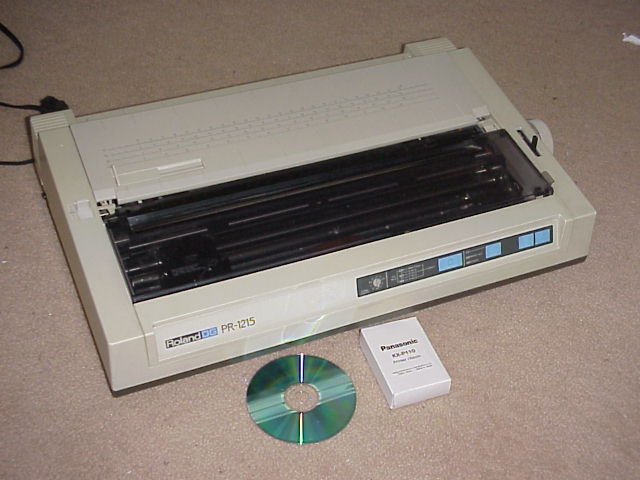
rueger writes "I can remember trading up from a daisy-wheel printer to dot matrix, and can remember when Jerry Pournelle used to say 'Buy the most expensive HP printer you can afford.' Mine was a 4P. Times have changed, though, and I'm looking for trustworthy advice before buying a couple of new printers. Specifically, a B&W Laser with sheet feed scanner, and a color inkjet with a solid flatbed scanner for copying music. We want solid, reliable machines that will give a few years of small office service, that have reasonably cheap consumables, and that will "just work" with Windows and Linux. Network ready of course. Let me expand. These days there seems to be no market leader in printers — they tend to be cheap disposable items. Part of the reason is that it is hard to find any real user reviews of these machines — most of the comments on Best Buy or other sites are full of fanboy enthusiasm, or extreme negativity — nothing that can be relied on. Between those, and the sock puppets, and the astroturfing, there's nothing I'd trust. I do trust Slashdot, though, for things like this. People here are able to offer realistic advice and experience that can usually tell the story. So, I ask: who's making good printers these days?"
Displays

A Look Inside the 8K Theater Technology At the Newly Renovated Fiske Planetarium 44

An anonymous reader writes "Sky gazers at CU-Boulder's Fiske Planetarium are getting better, clearer and deeper views. And not just of astronomy anymore. The planetarium has been upgraded, transforming it into a digital IMAX-like theater that's open to the public every Saturday and Sunday with a variety of programs including shows for children. 'Fiske's refurbished video system projects ultra high-definition pictures at 8,000 by 8,000 pixels in size, giving audience members a crystal-clear 360-degree view on the dome’s 65-foot screen. "The size and quality is the equivalent of 40 Blu-ray players projecting 40 sections of one video image at once," said [Doug Duncan, director of Fiske]. This gallery of images shows a behind-the-scenes look at the Planetarium's brand new 8k Fulldome projection system. ' In addition to space odysseys and laser shows — longtime favorites of audiences — movies are now part of the Fiske lineup. 'Just like at an IMAX theater, we can take you near a black hole, through the Grand Canyon, under the ocean, or up to a super volcano,' said Duncan. "The sky is no longer the limit.'"
Hardware

Video Scenes from the Fort Wayne Regional Maker Faire (Video) 16

Slashdot visited Fort Wayne, Indiana, during its 2013 Maker Faire. We brought back videos of R2D2 model makers in all their bleeping glory, Mad Sasquatch Rocketry launching rockets, and functioning home-made jet engines, which no Maker Faire should be without. Since Fort Wayne has a strong industrial history, it is not surprising that this Maker Faire had more industrial-scale exhibits than most maker-type events Slashdot has attended. The noise level in much of the event area was industrial scale, too, which is why this video sounds the way it does. But we love large, noisy machinery, not just computers so quiet you can't hear their fans (if, indeed, they *have* fans), so we're happy to enjoy some good Industrial Sound and check out some of Mark Phenicie's steampunk creations now and then.
Input Devices

USB Implementers Forum Won't Play Nice With Open Hardware 273

DeathToBill writes "Hack A Day reports on the attempts of open hardware hackers to obtain a vendor and product ID for their devices to be able to sell them as USB compliant: 'A not for profit foundation [in this case Arachnid Labs] could buy a VID, give PIDs away to foundation members making open source hardware, and we would all live in a magical world of homebrew devices that are certified as USB compliant.' The USB Implementers Forum, which controls the sale of PIDs, has lawyered up, responding to the effort with a cease and desist notice, requiring Arachnid Labs to stop 'raising funds to purchase a unique USB VID' and 'delete all references to the USB-IF, VIDs and PIDs for transfer, resale or sublicense from your website and other marketing materials.' A slight over-reaction? Or dark conspiracy against open hardware? You decide!"
Windows

Why Does Windows Have Terrible Battery Life? 558

An anonymous reader writes "Jeff Atwood at Coding Horror is trying to figure out why the battery life for devices running Windows is so much worse than similar (or identical) devices running other operating systems. For example, the Surface Pro 2 made great strides over the original Surface Pro, increasing web-browsing battery life by 42%, but it still lags far behind Android and iOS tablets. The deficit doesn't get any better when Windows is run on Apple hardware. Atwood says, 'Microsoft positions Windows 8 as an operating system that's great for tablets, which are designed for casual web browsing and light app use – but how can that possibly be true when Windows idle power management is so much worse than the competition's desktop operating system in OS X – much less their tablet and phone operating system, iOS?' Anand Lal Shimpi is perplexed, too. Atwood is now reaching out to the community for answers: 'None of the PC vendors he spoke to could justify it, or produce a Windows box that managed similar battery life to OS X. And that battery life gap is worse today – even when using Microsoft's own hardware, designed in Microsoft's labs, running Microsoft's latest operating system released this week. Microsoft can no longer hand wave this vast difference away based on vague references to "poorly optimized third party drivers." ... I just wish somebody could explain to me and Anand why Windows is so awful at managing idle power.'"
Transportation

New York City To Get Manhole Covers That Wirelessly Charge Electric Vehicles 112

Lucas123 writes "A new project between NYU and start-up HEVO Power will disguise wireless charging stations in manhole covers. The wireless charging stations are aimed at providing fleets of delivery vehicles with power in parking spaces around the city. Next year, Toyota plans to test a wireless charging Prius in Japan, Europe. And, U.S. Auto electronics giant Delphi is developing technology for electric vehicles that could be used industrywide. The charging stations could be embedded in asphalt or pads that lay on garage floors. Wireless charging, however, still has many obstacles to overcome, including the time it takes to recharge a vehicle, cost to deploy the technology and power loss during electrical transfer."
Graphics

Freedreno Graphics Driver Gets PRIME, Render Node Support 14

Via Phoronix comes news that the new DRM driver for the Freedreno driver for Qualcomm Snapdragon Adreno graphics is gaining a few new features in Linux 3.13: "After a year of working on the 'Freedreno' Gallium3D user-space driver and getting that up to speed for Qualcomm Adreno/Snapdragon support, for the past few months he's been working on a complementary kernel driver rather than relying upon Qualcomm's Android-focused kernel layer. ... The work that Rob has ready for Linux 3.13 with this Qualcomm DRM graphics driver is DRI PRIME support, support for render nodes, updated header files, plane support, and a couple of other changes."
Networking

Your Next Network Operating System Is Linux 192

jrepin writes "Everywhere you look, change is afoot in computer networking. As data centers grow in size and complexity, traditional tools are proving too slow or too cumbersome to handle that expansion. Dinesh Dutt is Chief Scientist at Cumulus Networks. Cumulus has been working to change the way we think about networks altogether by dispensing with the usual software/hardware lockstep, and instead using Linux as the operating system on network hardware. In this week's New Tech Forum, Dinesh details the reasons and the means by which we may see Linux take over yet another aspect of computing: the network itself."
Hardware

Are We Socially Ready For Wearable Computing? 214

An anonymous reader writes "Smart watches have arrived, and Google Glass is on its way. As early-adopters start to gain some experience with these devices, they're learning some interesting lessons about how wearable computing affects our behavior differently from even smartphones and tablets. Vint Cerf says, 'Our social conventions have not kept up with the technology.' Right now, it's considered impolite to talk on your cellphone while checking out at the grocery store, or to ignore a face-to-face conversation in favor of texting somebody. But 20 years ago, those actions weren't even on our social radar. Wearable devices create some obvious social problems, like the aversion to Glass's ever-present camera. But there are subtler ones, as well, for which we'll need to develop another set of social norms. A Pebble smart watch user gave an example: 'People thought I was being rude and checking the time constantly when I was really monitoring incoming messages. It sent the wrong signal.' The article continues, 'Therein lies the wearables conundrum. You can put a phone away and choose not to use it. You can turn to it with permission if you're so inclined. Wearables provide no opportunity for pause, as their interruptions tend to be fairly continuous, and the interaction is more physical (an averted glance or a vibration directly on your arm). It's nearly impossible to train yourself to avoid the reflex-like response of interacting. By comparison, a cell phone is away (in your pocket, on a table) and has to be reached for.'"
Cellphones

Sleeper: LG G2 One of the Fastest Android Smartphones On the Market 108

MojoKid writes "The LG G2 is the follow-up to LG's Optimus G Pro. It's also one of the few smartphones on the market right now powered by Qualcomm's Snapdragon 800 quad-core SoC. The G2 sports a 5.2-inch 1080p display, 2GB of RAM and up to 32GB of on board storage. However, the 2.26GHz quad-core Snapdragon 800 chip on board also has Qualcomm's Adreno 330 GPU that even gives NVIDIA's Tegra 4 a run for its money in gaming and graphics performance. Though the G2 has a rather unorthodox volume rocker and power button assembly on the back of the phone, once you get used to the location, it's actually a pretty comfortable control system. What's pretty impressive though is the G2's performance combined with its 3000mAh battery that offers a solid balance of horsepower and battery life and rivals flagship phones like the Samsung Galaxy S4 and Apple's iPhone 5S."
Power

Carbon-Negative Energy Machines Catching On 228

An anonymous reader writes "All Power Labs in Berkeley, California has produced and sold over 500 machines that take in dense biomass and put out energy. What makes the machines special is that instead of releasing carbon back into the atmosphere, it's concentrated into a lump charcoal that makes excellent fertilizer. The energy is produced cheaply, too; many of the machines went to poor nations who normally pay much more per kilowatt. '[T]he PowerPallets are still relatively simple, at least as far as their users are concerned. For one, thing Price explained, much of the machine is made with plumbing fixtures that are the same everywhere in the world. That means they're easy to repair. At the same time, while researchers at the 50 or so institutions that have bought the machines are excited by opening up the computer control system and poking around inside, a guy running a corn mill in Uganda with a PowerPallet "will never need to open that door and never will," Price said.'"
Data Storage

OCZ May Be On Its Last Legs 292

itwbennett writes "OCZ, one of the first commercial solid-state drive (SSD) makers has been blaming a shortage of NAND for its woes for some time now, but things have taken a precipitous turn for the worse: 'For its second fiscal quarter ended August 31, 2013, revenue was $33.5 million, a huge drop compared to revenue of $55.3 million for the first quarter of 2013 and revenue of $88.6 million for the second quarter of 2012. The net loss for this quarter was massive, $26 million, a doubling of the $13.1 million loss in the same quarter last year.' The company has burned through cash, its stock collapsed, and now so have sales. Meanwhile, other SSD makers are doing well. So what is happening here?"

Slashdot Top Deals